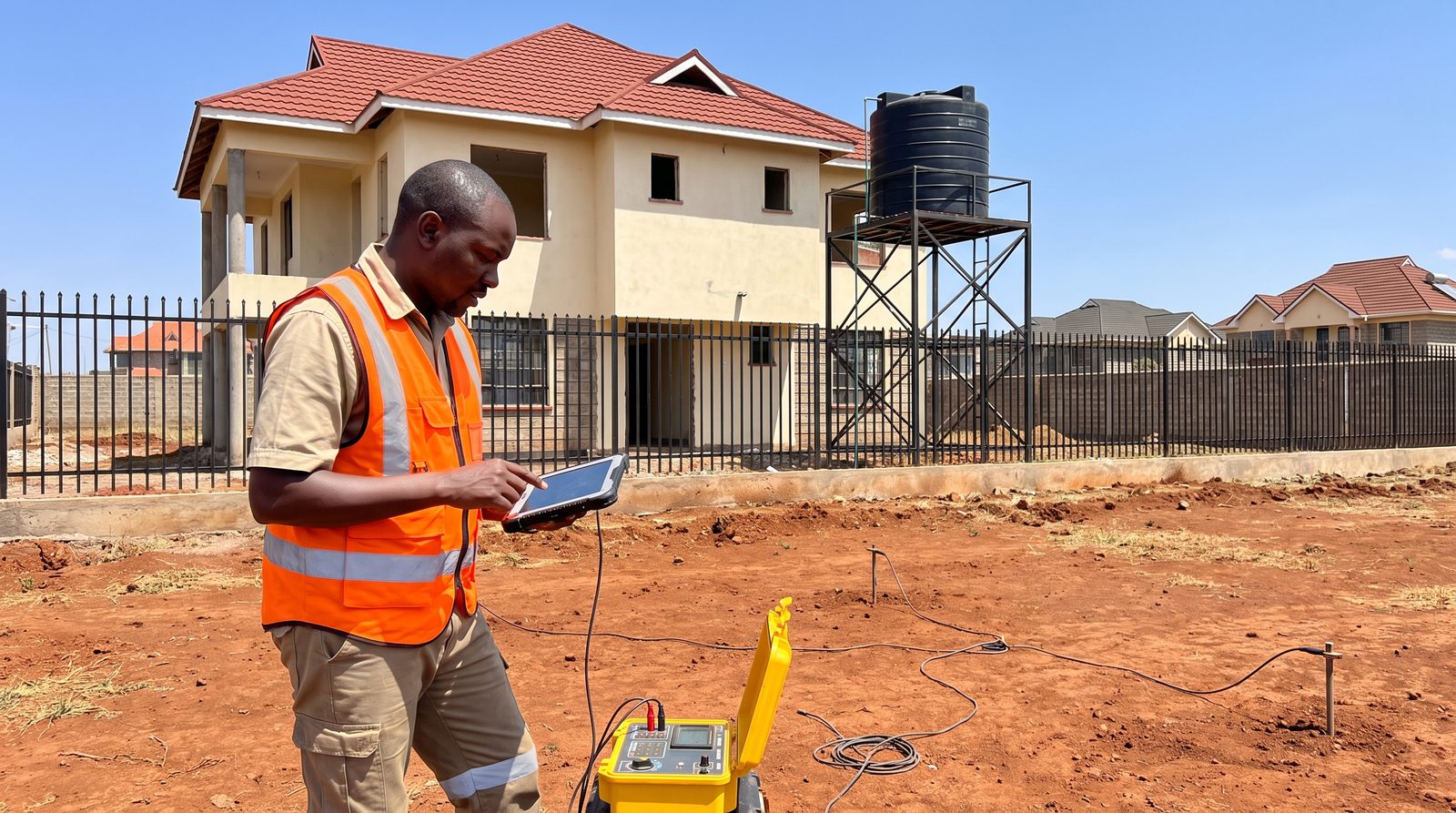
Hydrogeological Survey
Required before you can drill
A geologist maps the aquifer, marks the drilling point and writes the report the Water Resources Authority needs. Skip it and you risk paying for a dry hole.
FromKES 40,000
Get a quote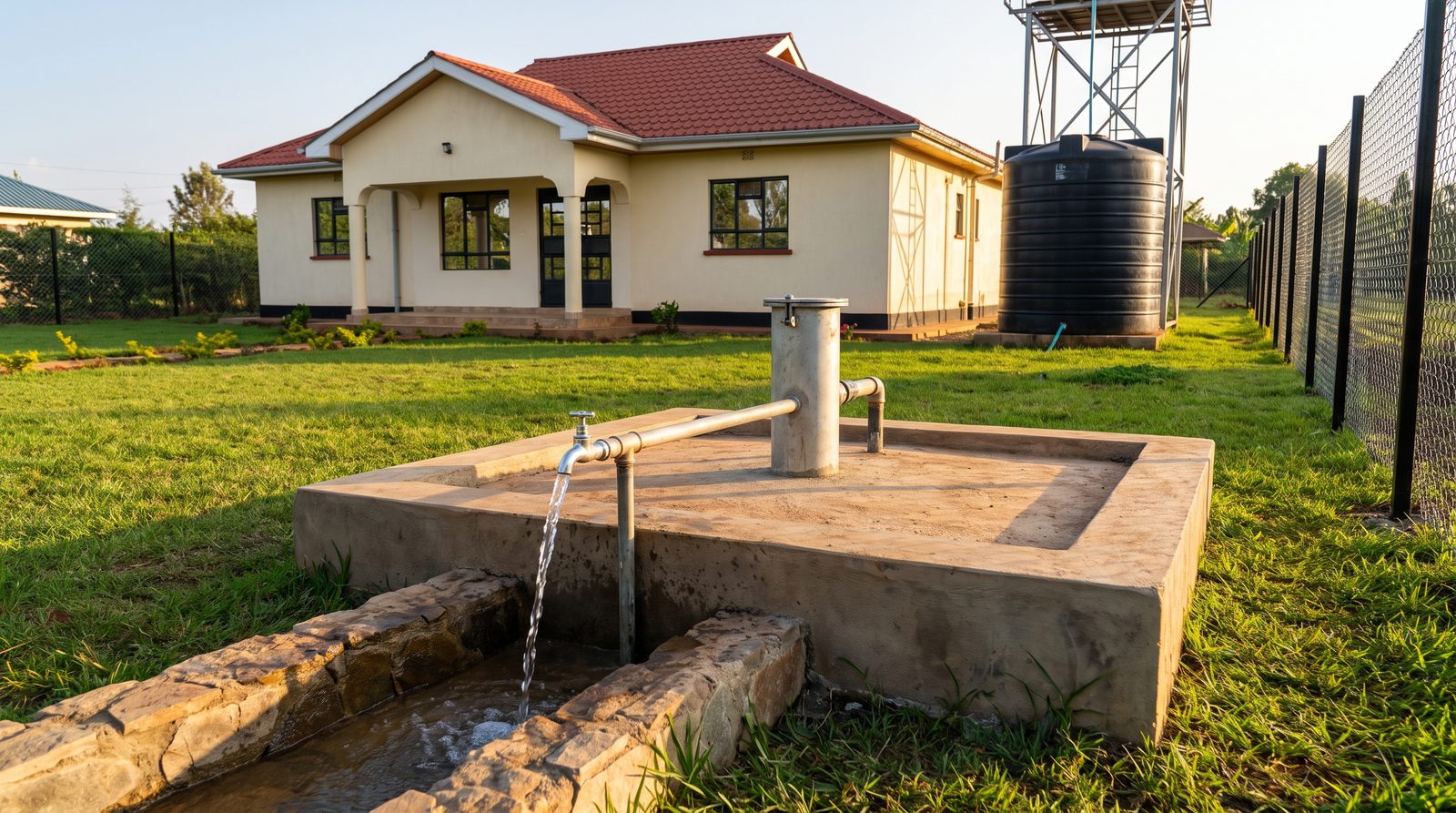
The plain version, before you spend a million shillings on one.
Get a free quote✓ Countrywide, all 47 counties
A borehole is a narrow, deep hole drilled straight down into rock to reach an aquifer, then lined with casing and fitted with a pump. In Kenya they are typically 50 to 250 metres deep and about 150 to 200 millimetres wide.
The short version of the difference from a well: a well is wide, shallow and usually hand dug into soil; a borehole is narrow, deep and machine drilled into rock. That is why borehole water is generally cleaner and far more reliable in a dry season.
A hand-dug well reaches the shallow water table, which is the first water below the surface and also the water most exposed to whatever is on the surface: latrines, livestock, run-off. It is cheap and it fails in a drought.
A borehole goes past that into a deeper confined aquifer protected by rock above it. It costs far more, it needs permits and a rig, and it keeps producing when the shallow water table has dried up.
Boreholes are usually described by how they are drilled and how they are equipped. Air rotary is used in rock and is the common method in the Nairobi metro. Mud rotary is used in loose ground and costs about double per metre. Manual drilling is limited to shallow, soft ground.
On equipping, the split is electric submersible, solar, or a hand pump on a shallow low-demand hole.
From the surface a finished borehole is almost nothing: a capped pipe in a concrete apron, often inside a small chamber. Everything that matters is underneath, and knowing the parts is what lets you read a quote.
The hole itself is drilled several inches wider than the pipe that goes into it. That pipe is the casing, and it is what stops the walls collapsing and keeps shallow, dirty water from running down the outside of the hole into your clean water. Where the casing passes the water-bearing rock it is slotted, and that section is the screen: it lets water in while keeping sand out, which is why the slot size is a real engineering decision rather than a detail.
The gap between the casing and the rock is filled with graded gravel, the gravel pack, which acts as a filter and holds the formation back. Above the water-bearing zone that gap is sealed instead, so surface water cannot track down it. At the top sits the wellhead and the apron. At the bottom, hanging on a pipe with a cable running the full depth, is the pump.
That is the whole machine. Notice how much of it is about keeping water out rather than letting water in. That is the part cheap quotes economise on, because it is the part you cannot see.
A geologist surveys the plot and marks a point. The permits are applied for against that point. Then a rig arrives, and depending on your ground it drills one of two ways: air rotary, which hammers through rock and blows the cuttings out with compressed air, or mud rotary, which cuts more slowly and circulates a fluid that holds loose ground open while it works.
As the hole goes down, casing follows it. When the target depth is reached, the gravel pack is placed and the borehole is developed, which means flushing and surging it until the water runs clear and the fine material around the screen has been drawn out. Skipping development is invisible on the day and expensive later: an undeveloped borehole silts and its yield falls away.
Then it is test pumped, usually over many hours, to find out what it will actually sustain rather than what it can produce in a burst. A sample goes to a laboratory. Only after those two numbers exist can anyone size a pump honestly, which is why a pump quoted before test pumping is a guess.
The hole itself, drilled and cased properly, is a multi-decade asset. Casing class is what decides that: heavier uPVC and steel outlast thin uPVC by a wide margin, and casing is the line most often quietly downgraded to make a quote competitive. A borehole cased too thin can start collapsing within a couple of years, and re-drilling costs more than drilling right once.
The pump is the consumable. It works submerged, it runs whenever you draw water, and it will be replaced at some point in the borehole's life. That is normal and worth budgeting for rather than being surprised by.
The aquifer is the part nobody controls. Yield can fall as an area develops and more boreholes draw on the same water, which is one of the honest arguments for testing properly at the start: without that baseline you cannot tell a failing borehole from a falling water table, and the two have completely different remedies.
A borehole quote arrives full of terms nobody explains, so here they are in order. Yield is how much water the hole sustainably produces, measured in cubic metres an hour: it is the single most important number about your borehole and it comes from test pumping, not from the driller's optimism. Static water level is how far down the water sits when nothing is running. Draw-down is how far it falls while the pump works, and the gap between those two tells you whether your pump is sized correctly or slowly killing itself.
Development means flushing and surging the new hole until the water runs clear and the fines around the screen have been pulled out. Skip it and the yield you paid for quietly disappears over the first year. The screen is the slotted casing sitting against the water-bearing rock, and the slot size is an engineering decision, not a detail: too coarse and you pump sand, too fine and you strangle the flow.
Mobilisation is what it costs to get the rig to your plot and away again, which is why a cheap rate from a distant company is often not cheap at all. And the wellhead is the sealed cap and concrete apron at the top, which is the only part of the whole machine you will ever see.
The alternatives are worth naming honestly. A shallow well is cheaper and reaches water near the surface, which in much of Kenya is the water most exposed to whatever happens above it, and the first to fail in a dry season. It has a place on the right plot and it is not the same product.
Manual drilling sits between the two: cheaper than a rig, limited to soft ground and shallow depths, and genuinely useful where the geology allows. It cannot reach the deep confined aquifers that make a borehole reliable through a drought.
And then there is doing nothing, which is the right answer more often than this market admits. If your mains works and your bill is modest, the borehole is capital solving a problem you do not have.
It cannot create water that is not there. A survey can tell you the odds are good and the drilling can still come up dry, because nobody can see through rock. It cannot guarantee the yield you want either: the aquifer gives what it has, and a hole producing half a cubic metre an hour is not a failure of workmanship, it is the ground answering.
It cannot make water safe on its own. Whatever the rock contains comes up with it, which is why the analysis exists and why treatment is a separate decision priced separately.
And it cannot be moved. The permit is issued against a surveyed point on a specific parcel, and the hole is where it is for the life of the property. That is the strongest argument for doing the survey and the paperwork in the right order: everything downstream is permanent.
Rain falls, and some of it runs off into rivers while some soaks down through soil and rock until it reaches a layer that holds it. That layer is an aquifer, and it is not an underground lake despite how it is usually drawn. It is rock and sand with water in the spaces between the grains, moving slowly sideways, sometimes over decades.
Where that water sits close to the surface, a shallow well reaches it. Where it sits deep, or where the shallow water is dirty, you drill. A borehole is simply a narrow, cased, engineered hole that reaches a specific water-bearing layer and keeps everything above it out.
The layer you reach matters as much as the depth. A confined aquifer, trapped beneath impermeable rock, is protected from whatever happens on the surface: that is why deep borehole water is generally cleaner and more reliable in a drought than a shallow well, which is exposed to every season and every latrine uphill of it. When a driller talks about going deeper for better water, this is the mechanism they mean.
Not always, and this is the section most sites in this market leave out. If you are on a mains connection that runs reliably and your water bill is modest, a borehole is a large amount of capital solving a problem you do not have. The honest test is arithmetic: what did you spend on water last year, and how many days did you have none?
Where it becomes obvious is when water is an input rather than a utility. Farms and irrigation, rental blocks where tenants leave over supply, schools and clinics that cannot simply not have water, businesses that use it in a process. In those cases the borehole is not a saving, it is infrastructure, and the payback tends to be a few years rather than a decade.
The middle case is the metro fringe: Kitengela, Ruiru, Kikuyu, Ngong, Athi River, where mains either has not arrived or arrives on a rota. That is most of the people reading this. For them the question is usually not whether a borehole is worth it but whether their particular plot has water shallow enough to make the sums work, and only a survey answers that.
Storage and supply get confused constantly, so it is worth separating them. A tank stores water someone else delivered. It buys you a few days of buffer against a rationing schedule or a late bowser, and it is entirely dependent on that supply continuing to exist. A borehole is a supply. It makes water available on your own land, on your own schedule, and the tank becomes what it should have been all along: a buffer between the pump and the tap rather than your entire water strategy.
That is why the two are not alternatives and almost every borehole ends up with a tank on a tower beside it. The borehole produces, the tank stores, and the elevation gives you pressure without running the pump every time someone opens a tap.
It is also why the comparison people usually make, borehole versus tank, is the wrong comparison. The real one is borehole versus a lifetime of buying water from someone whose schedule you do not control.
Three different trades touch a borehole and people conflate them constantly, which is how quotes become confusing. The hydrogeologist finds the water: they survey the ground, mark the point and write the report the permits depend on. They do not own a rig and they are not the ones who will drill.
The drilling contractor owns the rig and makes the hole. They case it, gravel-pack it, develop it and test pump it. The rig itself carries a Water Resources Authority permit, and that permit is what you check.
The pump installer equips it. Often the same company does all three, and often it does not, and either arrangement is fine as long as somebody is accountable for the whole thing and you know who. Where it goes wrong is when the survey blames the driller, the driller blames the aquifer, and the pump supplier blames both, while you hold a hole that does not work.
There is no useful average, because depth is set by geology rather than by preference. In parts of the Nairobi metro water comes in near 100 metres; in drier counties 150 to 250 metres is normal.
Only the hydrogeological survey answers this for your specific site, and since depth is the main driver of cost, that survey is also the moment your budget stops being a guess.
Required before you can drill
A geologist maps the aquifer, marks the drilling point and writes the report the Water Resources Authority needs. Skip it and you risk paying for a dry hole.
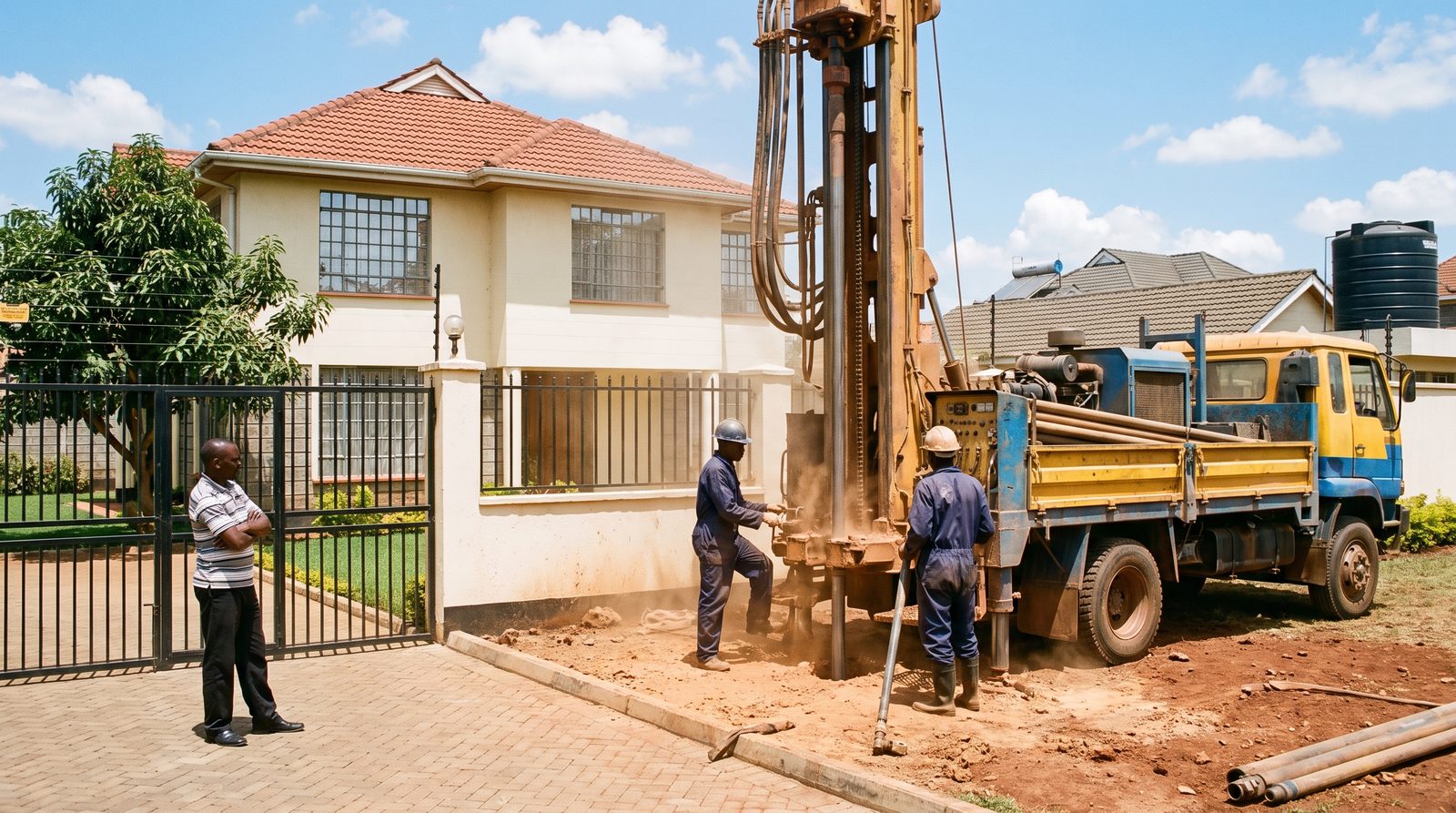
100m · air rotary · electric pump
The most common depth in the Nairobi metro. Covers the survey, permits, 100m of air-rotary drilling with casing, test pumping and an electric submersible pump.
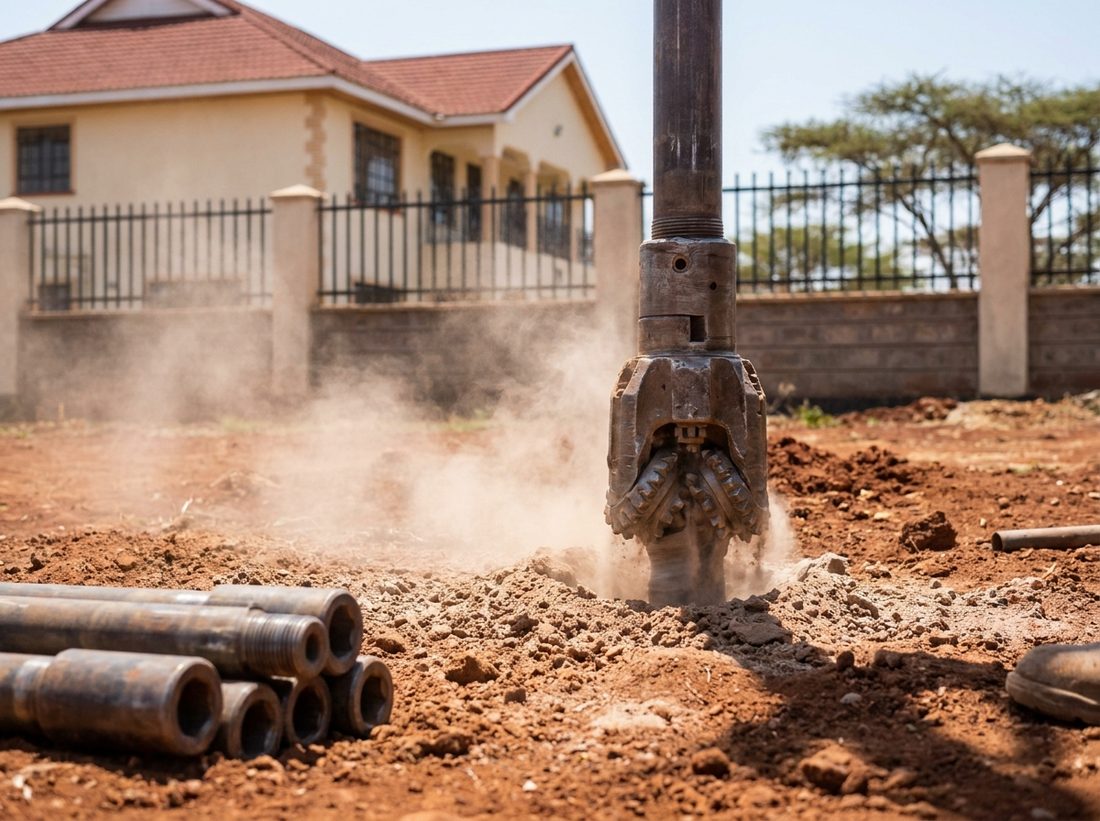
150m · air rotary · electric pump
Where the water table sits deeper, as in much of Kajiado, Machakos and the drier counties. Same scope as the 100m package with 50 more metres of drilling and casing.
Per metre · stable rock formation
The standard method where there is solid rock beneath. The per-metre rate already includes mobilisation, casing, graveling, well development and test pumping.
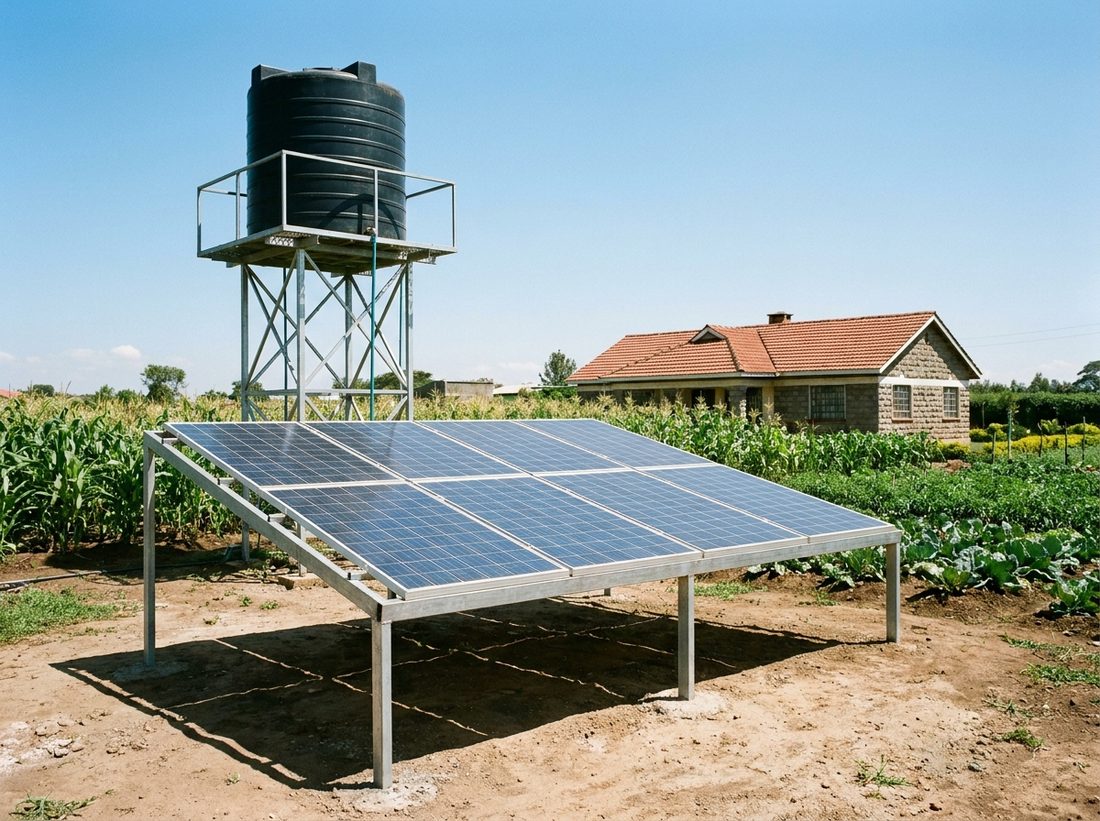
Solar pump, panels and controller
No power bill and no grid dependency, which matters on farms and off-grid plots. It costs more upfront than an electric pump and pays back through saved tokens.
Authorisation to drill
The Water Resources Authority permit and the NEMA environmental licence. Drilling without them is illegal and the borehole can be sealed.
A borehole is five jobs bundled into one: the survey that finds the water, the permits that make it legal, the drilling, the test that proves the yield, and the pump. We run all five for you, with licensed rigs and a quote broken down line by line, so you know exactly what you are paying for before anyone starts.
Tell us where the plot is and what the water is for. We will handle the survey, the permits and the drilling, and come back to you with the likely depth and what it will cost. Countrywide, all 47 counties.
Get a free quoteA narrow, deep hole drilled into rock to reach an aquifer, lined with casing and fitted with a pump. In Kenya they are usually 50 to 250 metres deep.
A well is wide, shallow and usually hand dug into soil, reaching the shallow water table. A borehole is narrow, deep and machine drilled into rock, reaching a protected aquifer. Borehole water is generally cleaner and far more reliable in a drought.
Typically 50 to 250 metres. Depth is set by the geology of your site, which is what the hydrogeological survey establishes, and it is the main thing that decides the cost.
Your own water supply, drilled by licensed contractors. Find out what your site needs and what it will take.
View Home →Every line of a borehole quote, priced at the 2026 market rate, so you can tell a fair number from a padded one.
View Cost →The step that decides whether your borehole finds water, and the report the Water Resources Authority will ask for.
View Survey →Cheaper than a rig, and strictly limited to shallow holes in soft ground.
View Manual Drilling →Clean at the source is not the same as safe to drink. What the tests look for and what to do about it.
View Water & Safety →