Hydrogeological Survey
Required before you can drill
A geologist maps the aquifer, marks the drilling point and writes the report the Water Resources Authority needs. Skip it and you risk paying for a dry hole.
FromKES 40,000
Get a quoteThe step that decides whether your borehole finds water, and the report the Water Resources Authority will ask for.
Get a free quote✓ Countrywide, all 47 counties
A hydrogeological survey in Kenya costs between KES 40,000 and KES 90,000. A geologist studies the site, maps the aquifer beneath it, marks the exact point to drill and estimates the depth and likely yield, then writes the report the Water Resources Authority requires before it will issue a permit.
It is the cheapest part of the project and the only one that tells you whether the expensive part is worth starting.
Required before you can drill
A geologist maps the aquifer, marks the drilling point and writes the report the Water Resources Authority needs. Skip it and you risk paying for a dry hole.
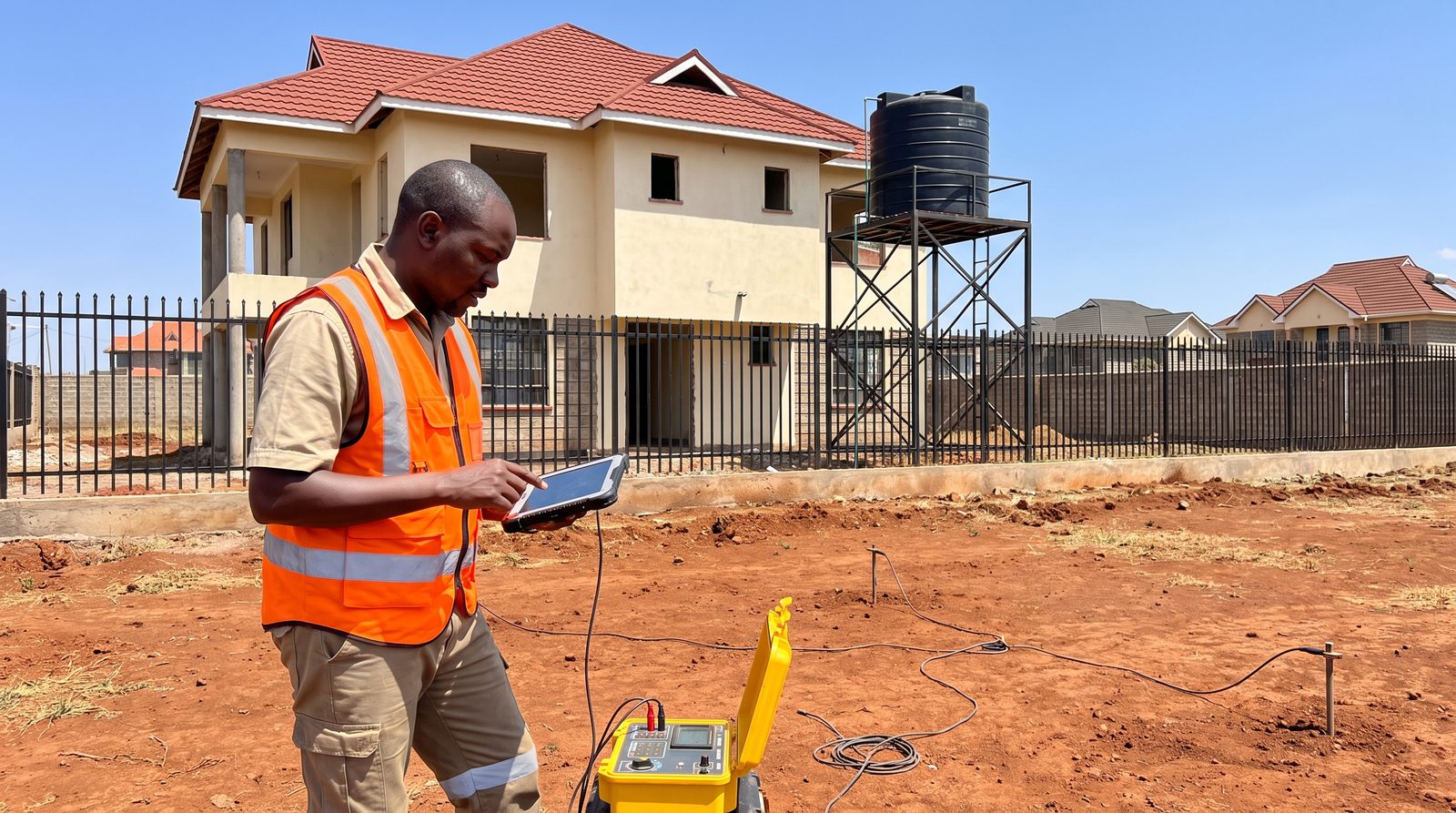
The survey combines desk study of the regional geology with field measurement, usually electrical resistivity or transient electromagnetic readings taken across the site. Those readings show where water-bearing rock sits and how deep it is.
You get back a marked drilling point, an estimated depth, an expected yield in cubic metres per hour, and the formal report for the permit application.
The report is the deliverable, not the site visit, and it is worth knowing what a complete one contains before you accept it: the regional geology, the field readings and how they were interpreted, a marked drilling point with coordinates, the target depth, the expected yield in cubic metres per hour, the recommended drilling method, and the geologist's details.
That last item matters more than it looks. The Water Resources Authority is receiving this document, and it needs to come from someone qualified to sign it. Ask who is writing your report before you commission it.
If the report concludes that your site is a poor prospect, that is not a wasted KES 40,000. That is the survey doing precisely the job you paid it for, at four per cent of what the dry hole would have cost you.
Depth is the biggest driver of cost, and ground type decides whether you drill with air rotary at about KES 6,700 a metre or mud rotary at about KES 15,050. Both come out of the survey. Until it is done, any quote you are given is a guess.
It also protects you from the worst outcome in this market. Drilling is billed per metre whether or not water is found, so a dry hole is a full bill for nothing.
Four things: how large and geologically complicated the site is, which method the geologist uses, how deep the target aquifer is expected to sit, and how hard the site is to reach with equipment. A flat plot on the Nairobi fringe and a remote sloping site in Kajiado are not the same day's work.
Quoted survey prices in Kenya vary more than any other line in a borehole. Published figures run from about KES 40,000 at the low end to KES 115,000 and above from the larger firms, for what is described as the same deliverable. That spread is exactly why you should ask what is in the report rather than compare the headline numbers.
A borehole is five jobs bundled into one: the survey that finds the water, the permits that make it legal, the drilling, the test that proves the yield, and the pump. We run all five for you, with licensed rigs and a quote broken down line by line, so you know exactly what you are paying for before anyone starts.
Tell us where the plot is and what the water is for. We will handle the survey, the permits and the drilling, and come back to you with the likely depth and what it will cost. Countrywide, all 47 counties.
Get a free quoteBetween KES 40,000 and KES 90,000 depending on the site and how much fieldwork is needed. The wider market runs higher: some established firms publish figures above KES 100,000 for the same deliverable, so compare what is in the report rather than the headline price.
In practice yes. The Water Resources Authority requires the survey report as part of the permit application, so you cannot legally drill without one.
You would be paying per metre to guess. Drilling is billed whether or not water is found, so skipping a KES 40,000 survey to protect a KES 1 million spend is the worst trade in this market.
The fieldwork is usually a single day. The report follows within a few days, and it then feeds the permit application, which is the slow part.
No, and be wary of anyone who says it does. It maps where water-bearing rock is most likely to sit and how deep, which massively improves the odds and is what the Water Resources Authority requires. It is a professional judgement about ground nobody can see, not a guarantee.
Then it has saved you the cost of a dry hole, which is the entire reason it goes first. A good geologist will also say whether a different point on the plot is a better prospect, or whether the site is simply not one.
A hydrogeologist, and the report needs to carry their details because the Water Resources Authority is the one receiving it. Ask who will write and sign your report before you commission the work, not after.
The geology does not change, but the paperwork can date and water levels move as an area develops and more boreholes draw on the same aquifer. If a report has been sitting for a year or more, expect the Authority to ask questions and expect the yield estimate to be optimistic.
Your own water supply, drilled by licensed contractors. Find out what your site needs and what it will take.
View Home →Every line of a borehole quote, priced at the 2026 market rate, so you can tell a fair number from a padded one.
View Cost →The survey, the WRA permit and the NEMA licence, in the order they actually happen.
View Permits →A term from your borehole quote, explained plainly.
View TEM survey →The plain version, before you spend a million shillings on one.
View Buyer's Guide →Compared on what actually matters: published pricing, licensed rigs and a quote you can read.
View Compare Drillers →