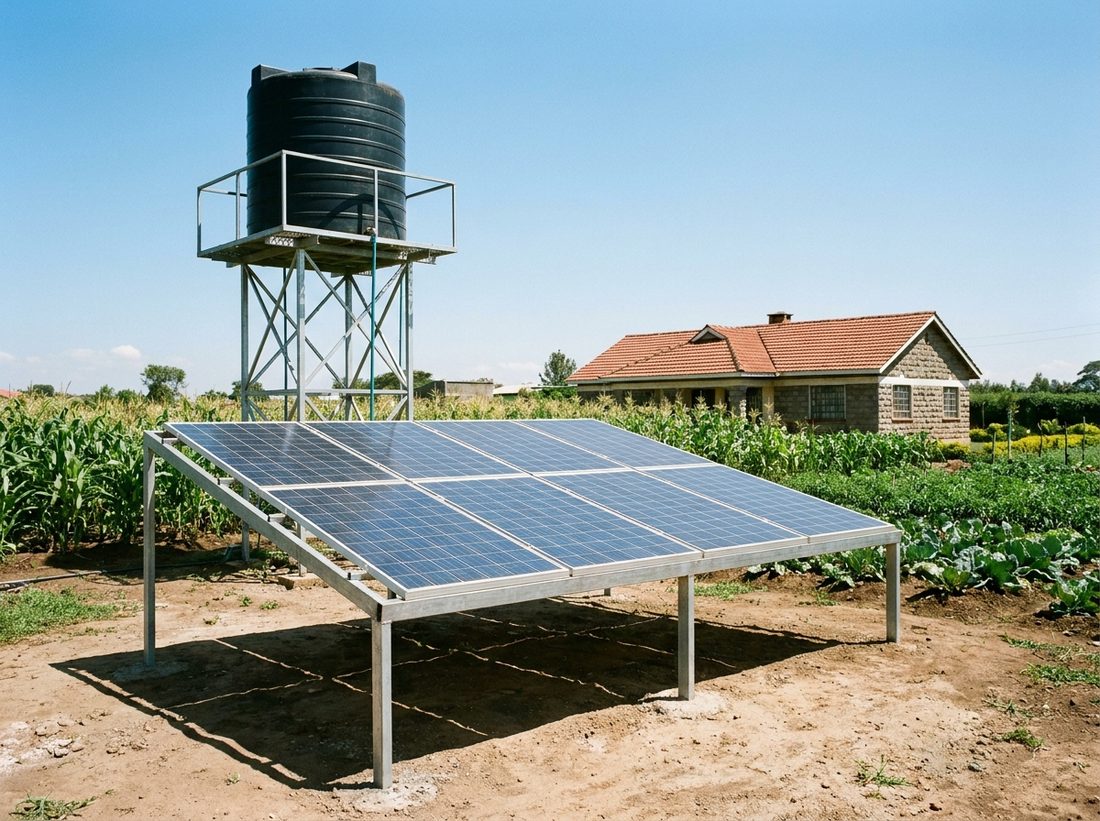
Solar Pumping System
Solar pump, panels and controller
No power bill and no grid dependency, which matters on farms and off-grid plots. It costs more upfront than an electric pump and pays back through saved tokens.
FromKES 250,000
Get a quoteMore upfront than an electric pump, then nothing to run. What a full system costs and when it pays for itself.
Get a free quote✓ Countrywide, all 47 counties
A solar borehole pumping system in Kenya starts from about KES 250,000 and can reach KES 800,000 on a deep, high-yield borehole. That is roughly KES 100,000 more than an equivalent electric submersible pump, and after that it costs nothing to run.
Solarising an existing borehole is common. If you already have a working hole and an electric pump, you are only buying the solar pump, the panels and a controller.
Solar pump, panels and controller
No power bill and no grid dependency, which matters on farms and off-grid plots. It costs more upfront than an electric pump and pays back through saved tokens.
Solar wins where power is expensive, unreliable or absent. On a farm pumping daily for irrigation, the tokens saved usually cover the price difference within two to three years, after which the water is effectively free.
It is a weaker case for a household on a stable grid connection pumping a few hours a week, where the payback stretches out and an electric pump is the cheaper honest answer.
A solar pumping system is the pump itself, the panel array sized to the pump, a controller or MPPT inverter, and the mounting. Panels are usually the largest single line, and the array has to be sized to the pump rather than the other way round.
The sizing relationship is fixed by physics, not preference. Published Kenyan listings show roughly one 300W panel for a 700W pump, two for a 1,200W pump, and three for a 1,300W to 1,400W pump. Deeper boreholes need more powerful pumps, which need more panels, which is why the array grows faster than the pump price as you go down.
Storage matters too. Most solar setups pump into an elevated tank during the day rather than using batteries, which is far cheaper and means you still have water at night.
This is the question the market quietly avoids, so it is worth being direct about. Most solar pump ranges published in Kenya top out around 80 metres of head, which is fine for a shallow hole and useless for the 100m to 150m boreholes that are normal across much of the Nairobi metro and the drier counties.
Deep solar pumping does exist. Manufacturers rate borehole solar pumps well beyond 200 metres of head, and complete solar borehole kits for around 120m are sold in Kenya. But you are then buying a bigger pump and a bigger array, and the price moves accordingly. If someone quotes you a cheap solar system without asking how deep your borehole is, the quote is for a pump that will not reach your water.
So the honest answer is yes, with a caveat: solar handles depth, but depth is what decides whether solar is a saving or an expensive way to be disappointed. Your test pumping certificate and static water level decide this, not a brochure.
An electric submersible pump installed runs from about KES 150,000; a solar pumping system from about KES 250,000, and considerably more on a deep hole. So solar starts roughly KES 100,000 behind and has to earn that back on running cost.
The arithmetic is simple enough to do yourself, and you should, because it turns on your own numbers rather than ours. Take what your borehole pump adds to your monthly electricity, multiply by twelve, and divide the extra capital cost by that. A site paying KES 8,000 a month to run a pump recovers KES 100,000 in about a year. A site paying KES 2,000 a month takes over four years, by which point you are into the pump's own service life and the case is much weaker.
This is why solar tends to win on farms, on irrigation, on off-grid plots and anywhere the pump runs for hours a day, and tends to lose on a household that pumps for twenty minutes into a tank. It is also why we will not quote you a payback period before knowing how much water you actually move. Anyone who quotes you a payback without asking that has not done the sum.
One real limitation to weigh: solar pumps while the sun is up. That is not a problem when you are filling a tank, and it is a problem if you need water on demand at four in the morning. Size the tank, not the battery.
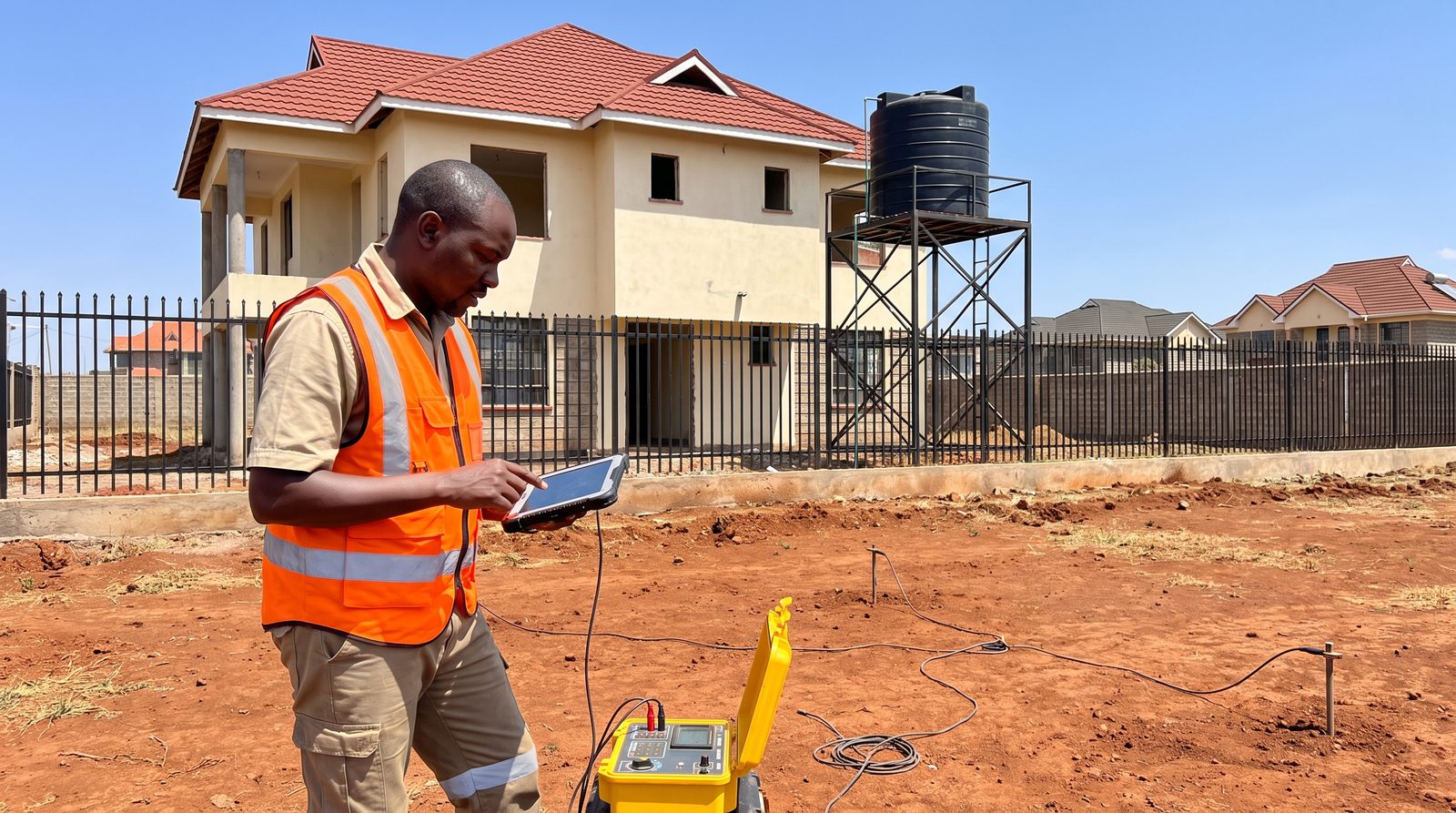
A borehole is five jobs bundled into one: the survey that finds the water, the permits that make it legal, the drilling, the test that proves the yield, and the pump. We run all five for you, with licensed rigs and a quote broken down line by line, so you know exactly what you are paying for before anyone starts.
Tell us where the plot is and what the water is for. We will handle the survey, the permits and the drilling, and come back to you with the likely depth and what it will cost. Countrywide, all 47 counties.
Get a free quoteFrom about KES 250,000 for a complete system, rising towards KES 800,000 on a deep, high-yield borehole.
On a farm or an off-grid plot, usually yes, with payback commonly in two to three years from saved power. For a household on a stable grid pumping a few hours a week, an electric pump is often the cheaper answer.
Yes. If the hole and casing are sound you are only buying the solar pump, the panels and a controller, which is why solarisation is cheaper than a new equipped borehole.
Your own water supply, drilled by licensed contractors. Find out what your site needs and what it will take.
View Home →What the pump costs, what the installed job costs, and how depth and yield decide which one your borehole can actually take.
View Pumps →Every line of a borehole quote, priced at the 2026 market rate, so you can tell a fair number from a padded one.
View Cost →A borehole that has stopped giving water is usually blocked, not finished.
View Maintenance →