Every line of a borehole quote, priced at the 2026 market rate, so you can tell a fair number from a padded one.
View Cost →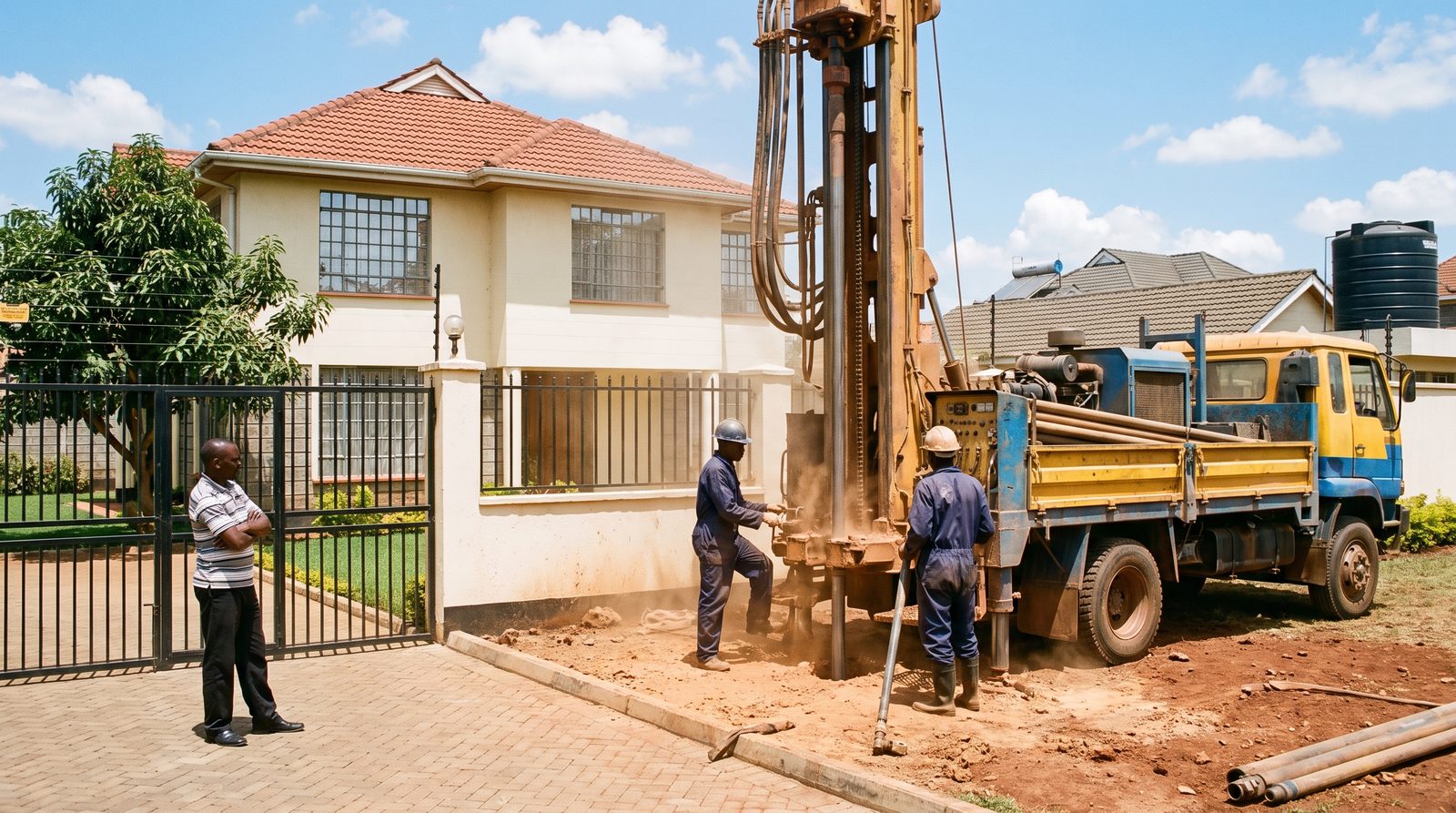
Kenya's borehole guide
Borehole Drillers in Kenya
Your own water supply, drilled by licensed contractors. Find out what your site needs and what it will take.
Get a free quote✓ Countrywide, all 47 counties
Survey first
We drill where the water is
Licensed rigs
Permit checked every job
Permits handled
WRA and NEMA sorted for you
Real market rates
Published per metre
Home
A borehole ends the water problem for good. No more rationing schedule, no more waiting on a bowser that comes when it comes, no more paying by the tank through a dry season. You own the supply, and on a farm or a rental block it usually pays for itself in a few years.
It is also a serious job with real requirements: a geologist has to confirm there is water under your plot, the Water Resources Authority has to permit it, and the rig has to be licensed. We handle all of it for you, and we publish what each step costs so you can see where your money goes before you commit.
How it works
One team, from the survey to running water
01
We survey your plot
A hydrogeologist confirms there is water under your land and how deep it sits, before anyone brings a rig.
02
We handle the permits
The WRA drilling permit and the NEMA licence, filed and followed up for you. This is the part people get stuck on.
03
A licensed rig drills
Air or mud rotary, whichever your ground needs, cased and gravel-packed to last, on a rig whose permit we check.
04
We test and fit the pump
Yield proven, water tested, pump sized to what the borehole actually gives. You get running water and both certificates.
The all-in number, at three depths
Everyone in this market quotes per metre and leaves you to do the multiplication. Here is the whole sum instead, from survey to water in the tank. Every line is the market rate published above, and the totals are simply those lines added up.
| Line | 50m | 100m | 150m |
|---|---|---|---|
| Hydrogeological survey | KES 40,000 | KES 40,000 | KES 40,000 |
| WRA and NEMA permits | KES 50,000 | KES 50,000 | KES 50,000 |
| Drilling and casing, air rotary | KES 335,000 | KES 670,000 | KES 1,005,000 |
| Wellhead and apron | KES 70,000 | KES 70,000 | KES 70,000 |
| Electric submersible pump | KES 150,000 | KES 150,000 | KES 150,000 |
| Total, from | KES 645,000 | KES 980,000 | KES 1,315,000 |
Air rotary at the published KES 6,700 a metre, which already carries mobilisation, casing, graveling, well development, test pumping and the water analysis. Mud rotary ground roughly doubles the drilling line. Solar instead of electric adds from about KES 100,000. These are floors, not quotes: your depth decides the real number.
Borehole drilling cost per metre, by county
Rates move with geology, water depth and how far a rig has to travel, which is why a metre in Bungoma and a metre in Turkana are not the same purchase. These are current market rates across Kenya, verified July 2026. Your own figure is set by the depth your survey finds.
| County | Region | Per metre | What drives it |
|---|---|---|---|
| Nairobi | Nairobi metro | KES 6,100 – 9,500 | Hard rock, but the most competitive market in the country |
| Kiambu | Nairobi metro | KES 6,500 – 9,500 | |
| Kajiado | Nairobi metro | KES 6,500 – 9,500 | Deeper water than Nairobi, so the total runs higher than the rate suggests |
| Machakos | Eastern | KES 6,500 – 9,500 | |
| Makueni | Eastern | KES 6,500 – 9,500 | |
| Kitui | Eastern | KES 6,600 – 9,500 | |
| Nakuru | Rift Valley | KES 6,500 – 9,500 | |
| Narok | Rift Valley | KES 6,800 – 9,500 | |
| Baringo | Rift Valley | KES 6,900 – 9,500 | |
| Uasin Gishu | Rift Valley | KES 5,800 – 6,100 | Among the cheaper counties to drill |
| Turkana | Northern | KES 8,000 – 9,500 | The most expensive county to drill: remote, and mobilisation is a long haul |
| Kisumu | Western | KES 5,950 – 6,500 | |
| Siaya | Western | KES 5,950 – 6,200 | |
| Bungoma | Western | KES 5,800 – 6,000 | The lowest per-metre rate in the country |
| Busia | Western | KES 7,700 – 9,500 | |
| Homa Bay | Western | KES 6,500 – 9,500 | |
| Mombasa | Coast | KES 7,000 – 9,500 | |
| Kilifi | Coast | KES 7,500 – 9,500 | |
| Kwale | Coast | KES 7,600 – 9,500 | Coral limestone, and salinity risk close to the shore |
Current market rates in Kenya, verified July 2026. The per-metre rate covers drilling, casing, graveling, well development and test pumping. It does not include the hydrogeological survey, the WRA and NEMA permits, or the pump.
Why drill with us
Your own water supply, done right the first time
A quote you can actually read
Every line itemised at the real market rate: survey, permits, drilling per metre, casing, testing and the pump. No single mystery number.
Priced by your ground, not your postcode
We survey before we quote, because depth and geology set the cost. Anyone who prices a borehole over the phone is guessing with your money.
Licensed rigs, permit checked every job
An unpermitted borehole can be sealed, and that loss lands on the landowner. We check the WRA permit for every rig we put on your plot.
We will tell you not to drill
If the survey says your site is a poor prospect, we say so. We would rather lose the job than sell you a dry hole.
Get a free quote
Free quote, no obligation · Countrywide, all 47 counties
The detail, if you want it
Everything about drilling a borehole in Kenya
The whole decision, laid out. Open any question that applies to you, or skip straight to a free quote above.
Does your plot actually have water?
This is the first question, and it is not answered by the driller. A hydrogeologist surveys the site, maps the aquifer underneath it and marks the point to drill. The report tells you the likely depth and yield before anyone brings a rig.
Depth is what your site dictates and what everything else follows from. In much of the Nairobi metro water sits around 100m; in parts of Kajiado and Machakos you may be drilling 150m or more. That is why nobody can quote you honestly over the phone.
From decision to running water
The drilling itself is quick, usually two to five days. The survey and the WRA and NEMA permits are what set your timeline, commonly four to eight weeks before a rig arrives. Plan on roughly two to three months from decision to water.
Then the borehole is tested to prove its yield in cubic metres per hour, the water is tested to confirm it is safe to drink, and a pump is sized to what the hole actually delivers. Ask for both certificates before the final payment.
What it will take
Expect from about KES 645,000 for a shallow 50m borehole and around KES 980,000 for a 100m borehole drilled and fully equipped. The drilling itself runs about KES 6,700 per metre in stable rock and KES 15,050 per metre in loose ground.
Almost nobody buys a borehole twice, so those numbers are hard to sanity-check. A quote is really five purchases bundled together: the survey, the permits, the drilling and casing, the test pumping, and the pump. We publish each line at the market rate so you can see what you are paying for.
Air rotary or mud rotary: your ground decides, not your budget
There are two ways to drill a borehole in Kenya and the difference is the biggest single swing in your bill. Air rotary blows the cuttings out with compressed air. It is fast, it is what most of the country needs, and it works wherever there is competent rock to hold the hole open. Mud rotary circulates a drilling fluid that holds the walls up while you cut, which is what loose, sandy or collapsing ground demands.
Air rotary runs about KES 6,700 a metre. Mud rotary runs about KES 15,050. That is not a markup, it is a different job: the drilling line alone goes from roughly KES 3,220 to KES 11,270 a metre because the work is slower, and the casing is heavier. On a 100m hole that difference is over KES 800,000.
You do not choose this. The survey does. Anyone who quotes you a method before looking at your ground is quoting a number they intend to revise once the rig is on site and you are committed.
How deep will your borehole be?
Depth is what your rate multiplies by, so it matters more than the rate itself. Across the Nairobi metro, water is commonly reached somewhere near 100 metres. In much of Kajiado, Machakos and the drier counties, 150 metres or more is normal. Published industry figures put the usual national range at roughly 120 to 250 metres.
This is why a cheap per-metre rate in a deep county can cost more than an expensive rate in a shallow one, and why comparing two quotes on rate alone tells you almost nothing. A KES 6,500 metre at 180m is KES 1.17 million of drilling. A KES 8,000 metre at 90m is KES 720,000. The cheaper rate is the more expensive borehole.
Nobody can tell you your depth over the phone, and the ones who try are guessing with your money. The hydrogeological survey is what turns your site into a number.
How to check a driller before you pay anyone
This market runs on trust and very little verification, so here is what to actually ask for. First, the rig's Water Resources Authority permit, current and in the name of the company quoting you. An unpermitted borehole can be sealed, and that loss lands on you as the landowner, not on the driller who has moved on.
Second, a quote broken down line by line: mobilisation, drilling per metre, casing per metre, graveling, well development, test pumping, water analysis, and the pump as a separate figure. A single bundled number is how margin hides. Third, two finished boreholes in your county that you can go and look at, and the owners' numbers.
Fourth, the test pumping certificate and the water chemical analysis before the final instalment leaves your hands. Those two documents are the only proof of what you actually bought. A contractor who has done this properly will hand them over without being chased.
Why the cheapest quote is usually the most expensive borehole
The arithmetic above is also the arithmetic of a bad quote. Casing is KES 2,269 of the KES 6,700 metre. Take the casing down a class, shorten the gravel pack, skip proper well development, leave the survey and permits off the sheet, and you can advertise a number nobody honest can match.
A threshold worth knowing: below about KES 5,000 a metre, casing has almost certainly been excluded or dropped to a thinner class, and a hole cased that way can collapse within eighteen to thirty-six months. You will not find out on the day. You will find out in year two, when the yield falls away or the walls come in, and re-drilling costs more than doing it once.
So when one quote sits far below the rest, the difference is almost never efficiency. It is something that has been removed from the hole and left in the quote.
What a borehole costs to own
The drilling is the capital cost, not the whole cost, and almost nobody tells you the rest before you sign. An electric pump adds to your power bill every month it runs, which is the running cost that makes solar worth the higher upfront figure on farms and irrigation. Pumps are consumables on a long timescale: they wear, and they get replaced.
Set against that, what you stop paying. A household on trucked water at KES 15,000 a month is spending KES 180,000 a year to be at the mercy of someone else's schedule. A rental block or a farm can be spending several times that. That is the number the borehole is competing against, and it is why the payback on a farm or a rental is usually a few years rather than a decade.
For a single household on a mains connection that actually works, the case is genuinely weaker, and we would rather say so now than sell you a hole you did not need.
Who this is worth it for
Farms and irrigation are the clearest case: water is an input to income, and the supply has to be there when the crop needs it, not when the schedule allows. Rental blocks and gated developments are next, because tenants leave over water and a bowser bill scales with every unit you add.
Schools, clinics and institutions are drilling for reliability rather than savings, and the sums usually work anyway at that volume. Businesses that use water as a process input, from car washes to food handling, tend to find the payback is under two years.
Then there are households on the metro fringe, in Kitengela, Ruiru, Kikuyu, Ngong and Athi River, where the mains either has not arrived or arrives on a rota. That is the biggest group of people reading this page, and for them the honest test is simple: add up what you spent on water last year, and how many days you had none.
Is there free borehole drilling in Kenya?
It is one of the most searched questions in this market, so it deserves a straight answer: not commercially. Boreholes do get funded by county governments, by NGOs and through community water projects, and those are allocated through those programmes rather than ordered by a landowner. If you own the plot and want your own supply on it, you are paying for it.
What you can do is share the cost. Neighbouring plots sometimes drill one borehole and split it, which changes the maths considerably and is worth raising with the people either side of you before you commit alone. Get the sharing agreement in writing, and put it against the title, because the borehole outlives the friendship.
Why a Nairobi metre and a Mombasa metre are different purchases
The county table above is not a price list, it is a map of geology. Around Nairobi you are drilling through hard volcanic rock, phonolite and trachyte, which is slow on the bit and hard on equipment but stands up without much help once it is open. That is air rotary country, and it is why the metro rate is competitive despite the rock being difficult: there are more rigs here than anywhere else in Kenya.
At the coast the ground is coral limestone and sediment. Softer, faster, and more likely to need mud rotary to keep the hole from closing, with salinity to think about the nearer you are to the sea. In the Rift, volcanic ash and loose fill mean the same problem for a different reason. Out in Turkana and the northern counties nothing about the rock is the issue; the cost is getting a rig there at all, which is why it carries the highest published rate in the country.
So a rate is really a sentence about your ground, your depth and your distance from the nearest rig, compressed into one number. Two quotes that differ by KES 2,000 a metre are usually not competing on margin. They are describing different jobs, and only one of them has looked at your plot.
What actually goes wrong
The dry hole is the one everyone fears and the rarest when a survey has been done properly, because the survey exists precisely to price that risk down. It still happens. Drilling is billed per metre whether or not water arrives, so ask what a dry hole costs you, and get the answer in writing before the rig moves.
More common is the disappointing hole: water, but not much of it. A borehole that yields half a cubic metre an hour is not a failure of drilling, it is what that aquifer had. This is why the test pumping certificate matters more than the depth certificate. It tells you what you can actually take out, day after day, and it is the number your pump must be sized against.
Then there is the slow failure, which is the expensive one. Thin casing, a short gravel pack, or well development skipped to save a day: the hole works on handover and starts silting or collapsing eighteen months later. By then the rig is three counties away. Almost every one of these traces back to a quote that looked like a bargain.
The last one is paperwork. A borehole drilled without the WRA permit can be sealed, and the enforcement lands on the landowner. The driller who told you not to worry about it is not the person who loses a million shillings.
What to ask on the first call
Five questions, and you can ask them before anyone visits. What is your WRA rig permit number? Is your quote itemised per metre, and does it include the survey, the permits, the wellhead and the pump, or are those separate? What happens if the hole is dry? Is VAT included? Can I visit two boreholes you finished in my county?
You will learn more from how those are answered than from the price. A contractor who has done this properly answers all five without pausing, because they have answered them a hundred times. Hesitation on any of them is your signal.
When you send us your site, that is roughly the conversation we have in reverse: we ask what county the plot is in, what the water is for and what you expect to use, because those three things decide whether a borehole is even the right answer for you. Sometimes it is not, and we would rather tell you that at the enquiry stage than at the invoice.
What a metre of drilling is actually made of
A per-metre rate is not a price for a hole. It is seven separate jobs bundled into one number, and the only reason air and mud rotary differ so much is the second line.
| Per metre | Air rotary | Mud rotary |
|---|---|---|
| Mobilisation | KES 420 | KES 420 |
| Drilling | KES 3,220 | KES 11,270 |
| Casing | KES 2,269 | KES 2,569 |
| Graveling | KES 280 | KES 280 |
| Well development | KES 70 | KES 70 |
| Test pumping | KES 420 | KES 420 |
| Water chemical analysis | KES 21 | KES 21 |
| Total per metre | KES 6,700 | KES 15,050 |
Current market rates in Kenya, verified July 2026. Both columns sum exactly. Note what is not in either: the survey, the permits and the pump.
What your per-metre quote does not include
This is where borehole budgets break. Someone is quoted KES 6,700 a metre, multiplies by 100, budgets KES 670,000, and is then billed closer to a million. Nothing dishonest necessarily happened: the rate was never the whole job. This table is our own reading of what the published per-metre rate covers and what it leaves for you to find.
| Cost | In the metre rate? | Typical |
|---|---|---|
| Mobilising the rig | Yes | In the rate |
| Drilling | Yes | In the rate |
| Casing and gravel pack | Yes | In the rate |
| Well development | Yes | In the rate |
| Test pumping and water analysis | Yes | In the rate |
| Hydrogeological survey | No | KES 40,000+ |
| WRA and NEMA permits | No | About KES 50,000 |
| Wellhead and concrete apron | No | KES 70,000+ |
| Pump and installation | No | KES 150,000+ electric |
| Tank, tower and plumbing to the house | No | Quoted per site |
| Power connection to the pump | No | Quoted per site |
| VAT | Usually not stated | 16% if charged |
Based on what the market's per-metre rate covers, set against the stages a complete job actually needs. Ask any contractor to confirm, in writing, which of the "No" rows their number already carries.
How long a borehole takes, stage by stage
The drilling is the fastest part of the job. Almost everyone is surprised by that, and it is why "we can have a rig there next week" should worry you rather than impress you: it means the paperwork is not being done.
| Stage | Typical time | Why |
|---|---|---|
| Hydrogeological survey and report | About 7 days | Nothing else can start until this exists |
| WRA and NEMA permits | 15 to 30 days | The slow part, and the part people try to skip |
| Drilling | 4 to 10 days | The bit everyone pictures. It is the shortest stage |
| Equipping the pump | 1 to 2 days | Sized to the yield the test pumping proved |
Typical stage durations in the Kenyan market, verified July 2026. Allow two to three months end to end. Permits and drilling cannot run in parallel: the permit is issued against the surveyed point.
Do you need a borehole drilled?
Tell us where the plot is and what the water is for. We will handle the survey, the permits and the drilling, and come back to you with the likely depth and what it will cost. Countrywide, all 47 counties.
Get a free quoteQuestions, answered
Frequently asked questions
Is a borehole worth it?+
On a farm, a rental block, a school or any site paying for trucked water, usually yes, and it often pays back within a few years. For a single household on a reliable mains connection the case is weaker. The honest test is what you currently spend on water and how often the supply fails.
How do I know if there is water under my plot?+
A hydrogeological survey answers this before you commit to drilling. A geologist maps the aquifer, marks the drilling point and estimates the depth and yield. It costs from KES 40,000 and it is also the report the Water Resources Authority requires, so it is not optional.
How long does a borehole take?+
The drilling itself is usually two to five days. The survey and permits take longer, commonly four to eight weeks, so the paperwork is what sets your timeline. Plan for two to three months overall.
Is borehole water safe to drink?+
Not automatically. Chemical analysis after drilling tells you what is in it. Kenyan groundwater is often hard or high in fluoride depending on the area, which is treatable, but you need the test result first. Insist on the certificate.
How much does it cost to drill a borehole in Kenya?+
From about KES 645,000 for a 50m borehole and KES 980,000 for a 100m borehole, drilled and equipped with a pump. The drilling alone is about KES 6,700 per metre in stable rock and KES 15,050 per metre in loose ground.
Do I need a permit to drill a borehole in Kenya?+
Yes. You need a Water Resources Authority permit and a NEMA environmental licence, and both need a hydrogeological survey report first. Drilling without them is illegal and the borehole can be sealed.
How much does it cost to drill a borehole per metre in my county?+
Published rates run from about KES 5,800 a metre in Bungoma to about KES 8,000 in Turkana, with most counties quoted between KES 6,500 and KES 9,500. See the county table above. Remember the rate is only half the sum: your depth is the other half, and only a survey gives you that.
How deep are boreholes in Kenya?+
It depends entirely on where you are. Around much of the Nairobi metro, water is commonly reached near 100m. Parts of Kajiado, Machakos and the drier counties run to 150m or beyond, and published industry figures put the typical national range at roughly 120m to 250m.
What if you drill and find no water? Do I still pay?+
Yes. Drilling is billed per metre whether or not water is found, which is exactly why the hydrogeological survey goes first: it costs from KES 40,000 against a drilling bill of several hundred thousand. Ask any contractor, including us, what happens to a dry hole before you sign, and get the answer in writing.
How do I know a borehole drilling company is licensed?+
Ask for the rig's Water Resources Authority permit number, current and in the name of the company quoting you, and verify it. Then ask for two finished boreholes in your county you can visit. A contractor who has done the work properly will offer both without being chased.
What is the difference between air rotary and mud rotary drilling?+
Air rotary blows cuttings out with compressed air and needs competent rock. Mud rotary circulates fluid to hold up loose or sandy ground. Air is about KES 6,700 a metre, mud about KES 15,050, and your geology decides which you need, not your budget.
Is there free borehole drilling in Kenya?+
Not commercially. Some boreholes are funded by county governments, NGOs or community water projects, and those are allocated through those programmes rather than ordered. If you own the plot and want your own supply, you are paying for it.
Explore more
The step that decides whether your borehole finds water, and the report the Water Resources Authority will ask for.
View Survey →The survey, the WRA permit and the NEMA licence, in the order they actually happen.
View Permits →What the pump costs, what the installed job costs, and how depth and yield decide which one your borehole can actually take.
View Pumps →